Worship Times
Sundays at 8am and 10:30am
Services at Historic St. Paul’s Church the first Sunday of every month at 5pm
Stay In Touch.
Get updates from our parish including calendar, service information and other text.
Authoritatively cultivate sustainable imperatives without transparent internal or "organic" sources. Professionally formulate long-term high-impact e-markets and scalable initiatives. Intrinsicly synergize excellent solutions after standards.
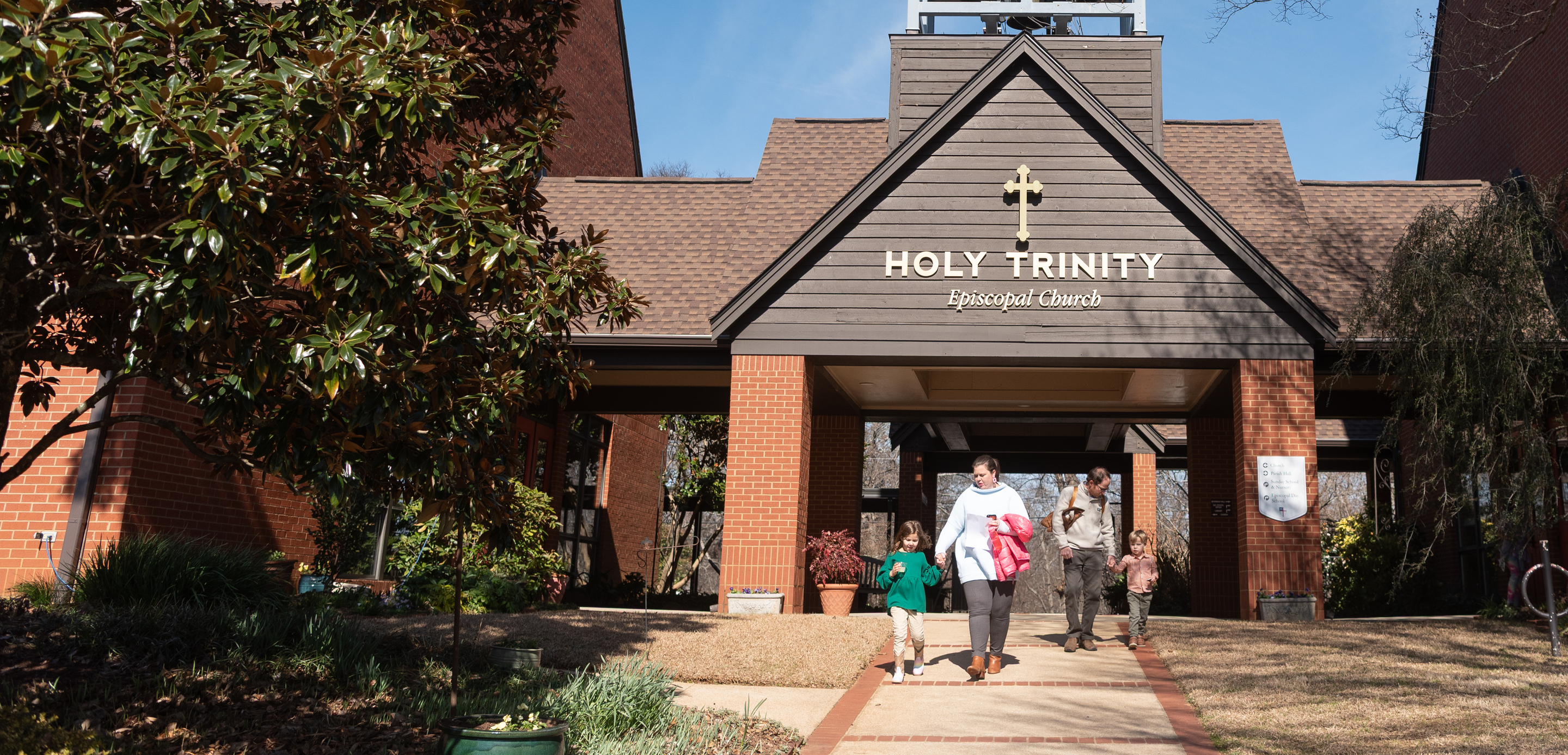
All are welcome here at Holy Trinity. That means you, too!
Holy Trinity is an Episcopal parish in the Diocese of Upper South Carolina. We are located just across the street from Clemson University. We’ve been here for over 125 years, and we are planning to be here for a good time longer.
Holy Trinity was founded in the last years of the 19th century as a chapel for students, faculty, and staff of then Clemson College. In the intervening years, this congregation has recommitted to that mission numerous times. We have deep ties to the university community, and our common life continues to be a liturgically-grounded parish whose members strive to live their lives through a deep understanding of the Anglican ideal of the via media, or the middle way. Here you will find young and old worshiping with serious intent in a parish atmosphere that is genuine, relaxed and come-as-you-are.
On our campus, you will discover people with big hearts and spirits: generous with their gifts and always stretching to understand what it means to be a Christian in today’s world. We find comfort in our deep loyalty to the Episcopal Church with its rich liturgy and prayer life. And we embrace the challenges of practicing our faith in a world too often engaged in cynicism and polarization. Holy Trinity welcomes people of every race, gender, gender identity, sexual orientation, marital status, age, physical and mental ability, national origin, economic station, and political ideology to full participation in the life of our community. God’s love flows to and through each of us.
Through God’s grace and the faithfulness of those who came before us, we continue to build a faith community that began over a century ago. Come join us in sharing the Good News that Christ is alive and there’s love enough to go around. All are welcome!
As Episcopalians, we follow Jesus Christ as our Lord and Savior. We put our trust in the Father, Son and Holy Spirit to bring us into life that is abundant now and eternal. We believe God is active in our everyday lives through the power of the Holy Spirit.
The mission of the Church is to restore all people to unity with God and with each other in Christ. The Church pursues its mission as it prays and worships, proclaims the gospel, and promotes justice, peace, and love. The Curch carries out its mission through the ministry of all the baptized.
We uphold the Bible and worship with the Book of Common Prayer. We believe the Holy Scriptures are the revealed Word of God. In worship we unite ourselves with one another to acknowledge the holiness of God, to hear God's Word, to offer prayer and praise, and to celebrate the Sacraments. Through the waters of baptism, nourished by God's word and the Eucharist, we warmly invite you into our common life.
Holy Trinity welcomes people of every race, gender, gender identity, sexual orientation, marital status, age, physical and mental ability, national origin, economic station, and political ideology to full participation in the life of our community. God's love flows to and through each of us. We strive to love our neighbors as ourselves and respect the dignity of every person. We welcome all to find a spiritual home in the Episcopal Church.
Holy Trinity Episcopal Church is a community of Christina believers who strive to love with the heart of Christ, to think with the mind of Christ, and to act in the world as the Body of Christ.
Everything we do begins with love. Our most important value is our trust in God, who created us for love; our trust in Jesus, who reveals God’s love to us, reconciling us to God and each other; and our trust in the Holy Spirit, who works within us to lead us along the Way of Love. Our worship of God is liturgical and sacramental, meaning that we use ancient forms of praise and prayer with fresh expression, and we regularly experience earthly signs of heavenly activity in our celebrations of Holy Baptism, Holy Communion, and other rites of the church.
The seeds of our faith are planted in the soil of fellowship with church friends, helping each other in times of trouble and celebrating in times of joy. The seeds of faith are nourished in Sunday school or Bible study, prayers with friends, or being formed by our Anglican/Episcopal tradition. We believe that the Hebrew and Christian Scriptures contain all things necessary for salvation. We follow the teaching of the ancient creeds of the church, declaring our loyalty to God, who creates, reconciles, and makes us holy (yes, holy, but not holier-than-thou!). We explore ways to apply our faith and learning to our daily living, which means we ask—and welcome—questions. We don’t, however, have all the answers.
We live out our faith by loving God with all our hearts, minds, bodies, and souls, which means we must also love our neighbors as ourselves. Our ministry is quite simply everything that we do for the sake of God’s love. We feed the hungry, visit the sick and lonely, promote educational equity for all, and provide shelter for the homeless. We work for justice, love mercy, and walk humbly with our God, respecting the dignity of every human being. We seek and serve Christ in everyone. We aren’t perfect at any of this, but we try hard.

When Thomas Green Clemson signed his will in 1883 with instructions to offer his estate, Fort Hill, to the State of South Carolina for the purpose of establishing “a scientific institution,” he set in motion circumstances which would lead to the founding of Holy Trinity Episcopal Parish on property adjoining the campus of what was originally formed as Clemson Agricultural College.
About four miles to the southeast of the College was the town of Pendleton. St. Paul’s Episcopal Church, established there in 1819, was the first Episcopal parish in the northwestern portion of the state. Rectors from St. Paul’s began ministering to Episcopal families in adjacent towns and communities, including those at Fort Hill. By 1895 the rector of St. Paul’s had begun holding services in the vicinity of Clemson College, or the prospective town of Calhoun, which was later incorporated as Clemson. The establishment of Clemson College increased the number of congregants in the Calhoun area. Accordingly, a plan was developed for a chapel near Clemson College. Holy Trinity Chapel was built in 1899 and consecrated on December 3rd of that year. Therefore, that day is considered the birthday of this parish. The shift in attendance from St. Paul’s to Holy Trinity led to its being designated an “Organized Mission” of the Diocese of South Carolina on January 2, 1901.
In his first report to the Diocese in 1901, Missionary-in-Charge, the Rev. Benjamin Anderson, noted 78 members spread among 19 families. He also noted that the monthly services attracted “70 Episcopalians among the college students, many of whom are communicants and regular attendants at the Sunday School and services of Holy Trinity.”
In 1902, the Rev. Kirkman Finlay was appointed Missionary-in-Charge and served Holy Trinity until 1907. During his tenure a rectory was built, in part employing Mr. Finlay’s own labor. Under the Rev. Finlay and in subsequent years Holy Trinity grew substantially. Accordingly, under the leadership of the next rector, the Rev. James Stoney, the Mission applied to the Diocese of South Carolina for parish status, which was granted in 1918. The Rev. Stoney took a leave of absence to serve in WW I, and he later became Bishop of New Mexico and Southwest Texas. When the Diocese of South Carolina was divided in 1922, Mr. Finlay. The former rector, was elected the first bishop of the newly-formed Diocese of Upper South Carolina.
In 1928 the wooden chapel was reoriented and bricked, and a bell tower was added, although no bells were installed until approximately 1960. Those bells now reside in the current belltower. At the same time, a parish house was built adjoining the church building with a vestibule. To honor Bishop Finlay, Holy Trinity named its parish house for the man who had shepherded the mission through its challenging early days. The parish house became a center of community activity, including basketball games, Cotillion Club dances and plays by the Clemson Little Theatre. It also served as a dormitory for young ladies visiting Clemson cadets.
In 1935, the Great Depression was still a major influence on all aspects of life. Faculty salaries were low, and recent graduates of Clemson College were joining the Civilian Conservation Corps and other government agencies. Since most communicants at Holy Trinity were employed by the College, cutbacks at the parish became severe enough that it reverted to Mission status in 1940.
However, with the influx of veteran students and their families after the end of WW II, and the conversion of Clemson College to a co-educational and civilian institution in 1955, Holy Trinity began a new cycle of growth, which ultimately led to the Mission being approved for reaffirmation to parish status in 1960. Also, in 1960 the Parish expanded its mission by establishing the Episcopal Day School. The new rector, the Rev. Marshall James, arranged for parishioner Rose Huff to move her home-centered day care center to Holy Trinity, and Mrs. Huff became the Day School’s first director.
With the building of the connected reservoir system of Lakes Hartwell, Keowee and Jocassee in the 1960’s and 70’s, much valuable real estate was created, attracting many new residents to the region.
As early as 1970, his first year as rector, the Rev. Thomas Davis, Jr. noted the poor condition of the physical facilities and placed a priority on their renewal. Validating jokes about how slowly change happens in an Episcopal church, it took a full twenty years until steps were taken to consolidate plans for construction of a new church building and parish house, and to provide greatly improved parking. Because of our ministry to the college community the vestry had on at least two occasions committed to remaining at our current location on what had come to be known as “Holy Hill”, shared with the Methodist Church. Finally, on September 10, 1995, the new church, erected on the site of the former rectory, was consecrated by Bishop Dorsey Henderson. Mr. Davis retired from Holy Trinity on December 31, 1995, with over 25 years’ service, the longest of any parish rector. The Rose Window was given in his honor to recognize his significant contributions to Holy Trinity.
The current parish house was dedicated in 1997, retaining Bishop Finlay’s name. In 2008 the Parish purchased from developers the former building and surrounding property of Clemson United Methodist Church, whose members had chosen to relocate on a larger but more distant site. This space currently houses Trinity Place, with the SAME (So All May Eat) Garden, green space, additional parking and an outdoor pavilion. Trinity Place was dedicated in 2020 by Holy Trinity’s first female rector, the Rev. Suzanne Cate, who was called in 2016.
At the time of construction of the church, the altar area was not satisfactorily completed, and the organ, which dated from 1977, needed updating. Accordingly, funds were raised to create a new reredos, and a replacement organ was installed.
The words of Holy Trinity’s mission statement, “to love with the heart of Christ, to think with the mind of Christ and to act in the world as the Body of Christ”, remind parishioners that the focus of the Church is always on God’s people. Physical facilities serve this mission not only by giving this small portion of the Church Universal a place to call home – a place to come together for worship and fellowship – but also a place from which to go forth in love and service. Indeed, the brick Jerusalem cross was placed between the buildings to remind those who pass by of Jesus’ Great Commission to carry the Gospel into all corners of the Earth.
For a book about Holy Trinity's first 125 years, containing much more detail and including anecdotes and photographs, contact the church office.